
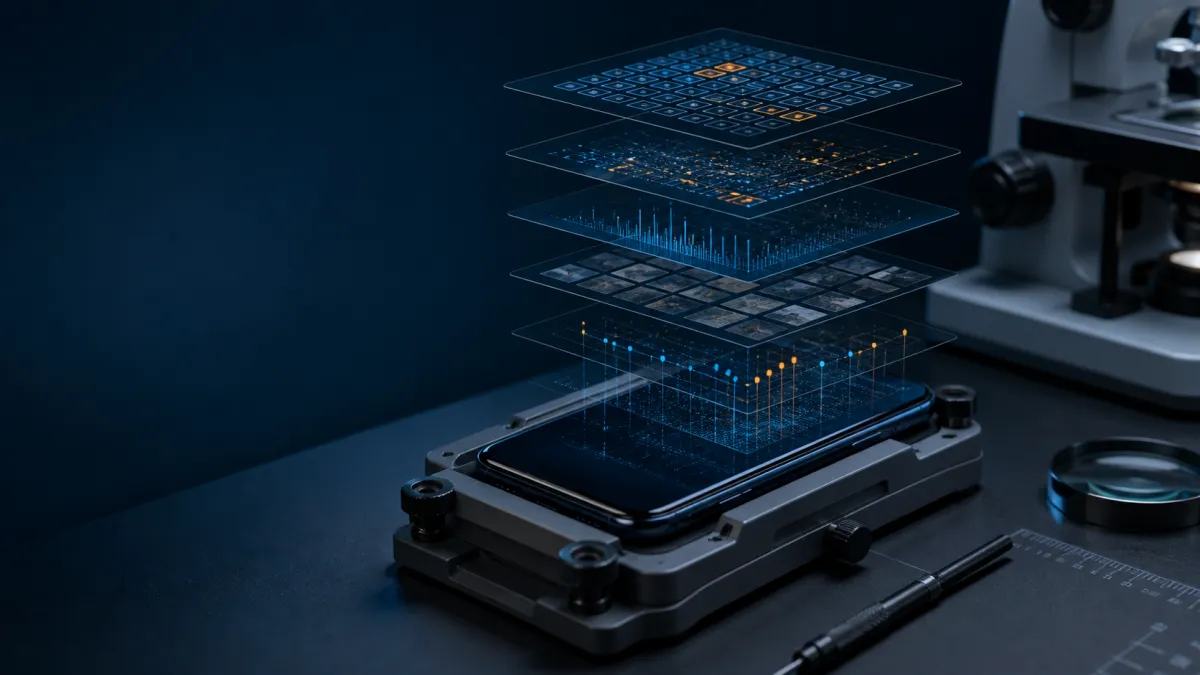
Deleted Doesn’t Mean Gone: What 2026 Research Reveals About Mobile Anti-Forensics
The most important evidence on a mobile device may no longer be where an examiner expects to find it.
A user deletes a conversation. An app promises disappearing messages. A privacy utility clears recent activity. The primary database appears empty, and an automated extraction report shows little of interest. It is tempting to conclude that the evidence is gone.
The [latest systematic research](https://doi.org/10.1016/j.fsidi.2026.302127) suggests a more careful conclusion: mobile anti-forensics often displaces evidence rather than completely erasing it.
That distinction is at the center of a [2026 systematic review published in Forensic Science International: Digital Investigation](https://doi.org/10.1016/j.fsidi.2026.302127). The researchers examined 197 anti-forensics studies published from 2005 through 2024. Within the mobile-focused subset, they cataloged 93 observations of residual evidence across 18 studies. Those traces persisted in places such as SQLite write-ahead logs, application and system logs, caches, and filesystem metadata.
For practitioners, the message is direct: a clean application view—or an empty table in a parsed database—is not necessarily the end of the examination.
Why mobile anti-forensics deserves attention now
Anti-forensics is not new. Investigators have long encountered encryption, file wiping, hidden data, altered timestamps, and tools intended to frustrate analysis. What is changing is the range of techniques and the ordinary mobile features that can produce similar effects.
Modern devices routinely use encrypted app containers, sandboxed storage, automatic cache management, synchronized cloud data, disappearing-message functions, private folders, and secure deletion options. Some are deliberate privacy protections. Others may be used to conceal activity. From the examiner’s perspective, both can change the availability and location of artifacts.
The [2026 review](https://doi.org/10.1016/j.fsidi.2026.302127) also found that anti-forensics research is moving beyond simple destruction toward deception, including fabricated or manipulated data. That creates two separate questions for an examiner:
1. What information may still survive?
2. Can the surviving information be trusted in its current context?
Recovery alone is no longer enough. Provenance, corroboration, and validation matter just as much.
The primary database is only one layer
Many mobile applications use SQLite to store structured information such as messages, contacts, account data, locations, and timestamps. A forensic tool may parse the main database and present the results in a clean report. That is useful—but incomplete if the associated database files are ignored.
In write-ahead logging mode, SQLite records changes in a separate -wal file before those changes are checkpointed into the main database. [SQLite’s official WAL documentation](https://sqlite.org/wal.html) describes the WAL as part of the database’s persistent state and warns that separating it from the database can lose committed transactions or damage the database copy. The related -shm file helps coordinate and locate frames in the WAL, as described in the [official WAL-mode file-format documentation](https://sqlite.org/walformat.html). Together, these files can contain a different view of recent activity than the primary database alone.
That does not mean every deleted record will be recoverable. WAL files can be checkpointed, overwritten, removed, or unavailable in a particular acquisition. It does mean that acquisition and analysis should treat the database, WAL, shared-memory file, and applicable journals as a connected set whenever possible.
The same layered thinking applies beyond SQLite. Residual evidence may appear in:
- Application or operating-system logs
- Cached files and temporary content
- Thumbnails, previews, or notification artifacts
- Filesystem names, sizes, paths, and timestamps
- Search indexes and usage databases
- Backups or synchronized services, when access is legally authorized
- Artifacts created by another app that interacted with the same content
No single artifact is guaranteed to tell the whole story. The value comes from correlation.
Android and iOS present different challenges
The [2026 systematic review](https://doi.org/10.1016/j.fsidi.2026.302127) found a significant platform imbalance in the research: Windows and Android dominated, while iOS and macOS were each represented by only six studies. Cross-platform validation was rare. The authors also noted that the mobile residual-evidence findings were heavily weighted toward Android.
That matters when translating research into casework. A result demonstrated on one Android version, device model, or application build should not automatically be assumed to apply to another device—or to iOS.
On Android, app-specific persistent files and cache data can occupy separate internal or external locations. [Google’s official Android storage documentation](https://developer.android.com/training/data-storage/app-specific) also notes that cache files may be removed by the system and that app-specific storage is removed when an app is uninstalled. Acquisition timing, device state, operating-system version, and the level of access obtained can therefore have a major effect on what is available.
On iPhone and iPad, third-party applications operate within tightly controlled sandboxes and have unique home directories, as explained in [Apple’s Platform Security documentation](https://support.apple.com/guide/security/security-of-runtime-process-sec15bfe098e/web). This architecture helps protect user data, but it can also limit what an acquisition exposes. The [2026 anti-forensics review](https://doi.org/10.1016/j.fsidi.2026.302127) found comparatively little iOS evidence in the literature, so broad claims about which residuals “should” exist deserve caution.
The practical lesson is not that one platform is easier. It is that platform, version, application, acquisition method, and time must be documented as part of every conclusion.
A more resilient examination strategy
When anti-forensic activity is suspected—or when expected evidence is simply absent—a disciplined workflow can reduce the risk of a false negative.
1. Preserve broadly and as early as authority allows
Volatile and temporary artifacts can change through ordinary device use, background synchronization, application launches, reboots, or storage cleanup. Follow the applicable legal authority, laboratory policy, and isolation procedure, and document the device state before interacting with it.
2. Keep related database files together
Do not examine a SQLite database in isolation if its WAL, shared-memory, or journal files are available. Preserve the original set, work from verified copies, and record which parser or method was used.
3. Look beyond the application’s user interface
What the application displays is not a complete representation of what the device stores. Correlate the primary database with logs, caches, thumbnails, filesystem metadata, notification records, and other available artifacts.
4. Build a timeline, not just a list of recovered items
A timestamp gains meaning when compared with application launches, database changes, file deletions, account activity, backups, or network events. A timeline may reveal whether a gap is consistent with normal application behavior, automatic cleanup, or deliberate action.
5. Validate important findings independently
Tool output is a lead, not the final conclusion. For a material artifact, verify the source path, raw value, timestamp interpretation, and relationship to other evidence. When practical, compare parsers or perform a manual check of the underlying data.
6. Test assumptions against the correct version
Application schemas and operating-system behavior change frequently. Record the device model, OS build, app version, acquisition method, tool version, and relevant parser version. Controlled testing with the same or a closely matched environment can help distinguish expected behavior from suspicious behavior.
7. Report limitations and negative findings clearly
“Not found” is not the same as “never existed.” State what data was available, what was inaccessible, which locations were examined, and what conditions may have affected recovery. This makes the conclusion more defensible and easier for another examiner to evaluate.
Three cautions that protect the integrity of the case
First, the presence of privacy or cleanup software is not proof of criminal intent. Secure folders, encrypted messaging, and data-management tools have legitimate uses. Intent must be established from the totality of the evidence, not inferred from an app icon.
Second, a recovered fragment is not automatically authentic or probative. Deception-oriented anti-forensics makes corroboration essential. Examiners should consider whether an artifact could have been generated, modified, imported, or attributed to the wrong user or time zone.
Third, the research base itself has limits. The mobile portion of the [2026 review](https://doi.org/10.1016/j.fsidi.2026.302127) covered 18 studies and was strongly Android-weighted. It maps what researchers have tested; it does not establish how often a technique appears in real investigations or guarantee that a particular artifact will survive.
The examiner’s new question
Mobile anti-forensics should change the question asked at the end of an extraction.
Instead of asking only, “Did the tool recover the deleted item?” ask:
“If the primary artifact is missing, what other systems would have recorded its creation, use, synchronization, modification, or removal?”
That shift—from searching for one object to reconstructing an event across multiple layers—is where many of the strongest mobile-forensics findings now emerge.
Deleted does not always mean gone. Sometimes it means the evidence has moved, fragmented, or lost its obvious label. Finding it requires broader acquisition, careful validation, and a willingness to examine the spaces between the main database and the final report.
---
Practitioner checklist
- Confirm legal authority and document the initial device state.
- Preserve the main database with its WAL, SHM, and journal companions.
- Examine app-private and operating-system artifacts when the acquisition permits it.
- Correlate logs, caches, previews, thumbnails, and filesystem metadata.
- Record device, OS, app, acquisition, tool, and parser versions.
- Validate material findings against raw data or a second method.
- Separate observed facts from interpretations about user intent.
- State access gaps, unsupported locations, and other limitations explicitly.
Sources and further reading
- [SoK: Anti-forensics evolution, platform coverage, and mobile residual evidence](https://doi.org/10.1016/j.fsidi.2026.302127), Forensic Science International: Digital Investigation (2026)
- [SQLite Database File Format: The Write-Ahead Log](https://sqlite.org/fileformat.html)
- [SQLite Write-Ahead Logging](https://sqlite.org/wal.html)
- [SQLite WAL-mode File Format](https://sqlite.org/walformat.html)
- [Android Developers: Access app-specific files](https://developer.android.com/training/data-storage/app-specific)
- [Apple Platform Security: App security overview](https://support.apple.com/guide/security/app-security-overview-sec35dd877d0/web)
- [Apple Platform Security: Security of runtime process](https://support.apple.com/guide/security/security-of-runtime-process-sec15bfe098e/web)
This article is intended for professional education. Acquisition and examination decisions should follow applicable law, legal authority, organizational policy, and validated laboratory procedures.